



Coffee Quality Assessment: From Farm to Cup


The world of coffee is filled with subtleties. From the moment a coffee cherry forms on the branches of the tree until it reaches your cup, it goes through a long journey full of intricate details. Along this journey, measuring coffee quality plays a crucial role. For farmers, buyers, and even baristas, understanding the criteria for evaluating coffee quality is extremely important. In this process, identifying and distinguishing high-quality coffee beans becomes essential to avoid choosing unsuitable products — a matter of increasing significance today for any Commercial coffee beans supplier in Iran.
When we talk about coffee, it is not only about flavor; visual characteristics, aroma, texture, and even the sound of the beans during grinding all contribute to its quality. Nowadays, the Iranian coffee market is filled with a wide variety of products, each claiming exceptional quality. For this reason, the ability to distinguish premium coffee from counterfeit or low-grade varieties has become more necessary than ever — especially for those operating as a Premium coffee beans supplier in Iran or businesses dealing with Roasted coffee beans wholesale in Iran.
The Core Stages of Measuring Coffee Quality
But what are the actual criteria for measuring coffee quality, and how can good coffee be distinguished from bad coffee? In this article, we take a deeper look at the main parameters of measuring coffee quality so that you, too, can select your preferred coffee with greater confidence — whether you are a professional barista looking for a brand like Felicita for your café or a home consumer searching for a high-quality coffee for daily use. Understanding these criteria is the most important step toward identifying good coffee from poor-quality options.
Coffee Grading: The International Language of Quality
Coffee grading is essentially an international standard that helps buyers and sellers determine the quality of coffee even without tasting it. Coffee is graded based on several criteria, the most important of which are bean size, defect count, and sensory attributes. This grading system is one of the most reliable methods for identifying high-quality coffee beans before roasting.
Unlike some other products, coffee does not have a single universal grading system; each producing country uses its own classification. For example, Grade 1 Indonesian coffee may differ significantly from Grade 1 Peruvian coffee.
In most coffee-producing countries, grading criteria are determined based on altitude, plant variety, number of defects, processing method, bean density, appearance after roasting, and of course, flavor quality.
These grading systems are so important that coffee prices are directly linked to grade. For instance, Kenya AA, which has a high grade, is usually more expensive than Kenya AB. Understanding these systems helps buyers make better purchasing decisions and choose coffee that meets their budget and expectations — especially those seeking high quality coffee brands in Iran.
Defect Counting: The First Step in Measuring Quality
Defect counting is one of the most important methods of evaluating coffee quality. Coffee beans are exposed to potential damage at various stages of production. Insects may harm the beans, processing machines may break them, and issues such as water shortage or over-fermentation can darken the beans.
All these factors can decrease the coffee’s quality and, in some cases, even make it unsafe for consumption. Therefore, the fewer the defects, the higher the coffee grade. Specialty Coffee Association (SCA) uses a system known as the “Green Arabica Classification,” which divides defects into primary and secondary categories.
Primary defects — such as full black beans, full sour beans, or severe insect damage — have significant effects on flavor. Secondary defects have smaller impacts and require larger quantities to be counted as a single defect. For example, one full black bean counts as one defect, but ten beans with minor insect damage are required to equal one defect. Therefore, minimizing defects is a key indicator of high-quality coffee, especially before roasting.
Bean Size: The Dimension of Quality
In the world of coffee, bean size is highly significant. Coffee beans come in various sizes, and their size affects both pricing and roasting behavior. In markets, bean size is measured using screens with round perforations. The largest size is 20/64 inch, and the smallest is 8/64 inch.
Before packaging, beans are placed in large screens and separated by gravity according to size. Bean size matters for two main reasons. First, in many countries, bean size directly correlates with price. For instance, Kenya AA is more expensive than Kenya AB. The common theory is that high-altitude coffees grow more slowly, have higher density, and produce larger beans.
However, this is not always the case; Ethiopian coffees are often smaller but exceptionally flavorful. Second, bean size affects roasting uniformity. If beans of varying sizes are roasted together, some will be over-roasted while others remain under-roasted, resulting in poor cup quality.
Cupping: The Art of Tasting and Evaluating Coffee
Cupping — the professional method of tasting coffee — is a standardized process used to evaluate the sensory quality of coffee and allow experts to analyze its characteristics in detail. In cupping, coffee is prepared using a fixed ratio of water to grounds, and the taster evaluates it using specific procedures.
The most well-known cupping protocol belongs to the Specialty Coffee Association (SCA), used by professionals worldwide. In this method, coffee is assessed for balance, sweetness, body, acidity, aroma, and flavor.
The cupping steps include smelling the dry grounds, breaking the crust formed after adding water, and finally tasting the coffee with a special cupping spoon. During tasting, the cupper slurps the coffee quickly and audibly to spread it across all parts of the mouth.
This allows them to perceive all flavors and textures. Their observations are recorded in standardized forms, ultimately producing a final score on a 100-point scale. Coffees scoring 80 or above are classified as specialty grade.
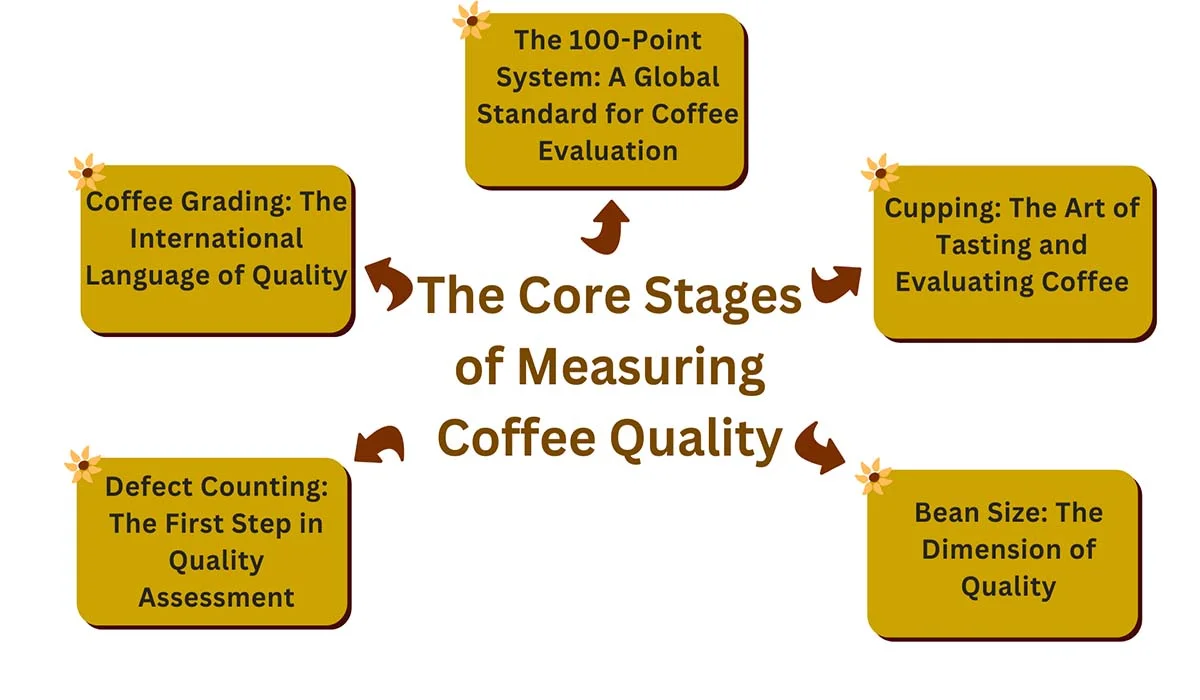
The 100-Point System: A Global Standard for Coffee Evaluation
Experts in the coffee sector recognize the SCA’s 100-point scoring system as one of the most reputable global standards for evaluating coffee quality. Introduced in 2004 and inspired by the wine industry’s 100-point scale, the system assigns a score from 0 to 10 to each attribute — aroma, body, acidity, sweetness, and balance.
The total score determines the final rating between 0 and 100. The higher the score, the better the overall quality. Evaluations are performed by certified professionals known as Q-graders, who undergo extensive training.
Ultimately, the best coffee is the one whose flavor and aroma most closely match your personal preference — just like the coffees from Parto Padideh Pars. So while understanding quality standards is important, trust your own palate and choose the coffee that gives you the greatest pleasure, whether it comes from Parto Padideh or any other brand.
Frequently Asked Questions (FAQ)
1. Why is Measuring Coffee Quality Important?
Because the quality of coffee beans directly affects the flavor, aroma, body, acidity, and the overall coffee-drinking experience. It also helps farmers, buyers, and consumers distinguish high-quality coffee from inferior or counterfeit samples.
2. What Are the Key Criteria for Identifying High-Quality Coffee?
The main criteria include bean size, number of defects, processing method, bean density, plant variety, cultivation altitude, sensory attributes, and the grading system of the producing country.
3. What Does Coffee Grading Mean?
Coffee grading is a standardized system for determining the quality of coffee beans. This system is usually based on bean size, number of defects, density, and sensory attributes. Each country may have its own specific standards.
4. What Are Coffee Bean Defects and How Are They Counted?
Defects include issues such as blackened beans, insect damage, cracking, or over-fermentation. In the SCA system, defects are divided into primary and secondary categories, and their number is counted in a given sample. The fewer the defects, the higher the quality.